
African American oral history stretches back to the West African griotic tradition, runs through the survival strategies of enslaved communities, and today lives inside some of the nation’s most significant digital archives and community-based projects. What makes Black oral history different from general archival work is its cultural roots. For centuries, storytelling has been the primary medium through which African American communities remembered who they were, taught one another how to survive, and imagined something better. Today, organizations rooted in those same traditions, among them the NMAAHC Oral History Initiative, the Bronx African American History Project, The HistoryMakers, and social enterprise media companies like Love Now Media, are bridging cultural memory with professional media production, ensuring the work continues with both craft and intention.
The griot tradition, known as jeli or djeli in Mande, gewel in Wolof, and gawlo in Fula/Pulaar, was firmly established by the formation of the Mali Empire in the 13th century and may have roots in earlier pre-imperial Mande communities. These were not simply performers. Griots belonged to specialized hereditary lineages and preserved genealogies, epic narratives, praise poetry, and political history through memorized oral performance, holding entire communal histories in spoken form across generations.
In Mande societies, the jeli served as genealogist, court counselor, diplomat, and legitimizer of political authority. Among the Wolof, gewel combined lineage memory with public announcement, courtly praise, and ceremonial leadership. Fula gawlo preserved clan history and ancestry while also serving as communicators across often dispersed pastoral communities. Across all three traditions, the core function was the same: a living archive with the authority that comes from mastery of inherited knowledge.
When enslaved Africans were brought to the Americas through the Atlantic slave trade, the griotic tradition traveled with them, stripped of its institutional form but not its purpose. Because enslaved people were denied legal literacy and control over written records, spoken narratives became the primary means of preserving cultural identity, transmitting practical survival knowledge, and asserting humanity in a system designed to erase it. Folktales, call-and-response patterns, trickster figures, and proverbs carried African values across generations in conditions of profound violence and suppression.
Coded animal stories, like those featuring Brer Rabbit, expressed criticism of enslavers indirectly while also modeling survival through cleverness. Storytelling created spaces, quilting bees, church meetings, front-porch conversations, that existed outside white institutional control. These were not workarounds or consolations. They were deliberate acts of resistance, cultural preservation, and community formation. During Jim Crow, oral tradition continued this work, with families teaching younger generations how to navigate segregated institutions and passing down accounts of racial violence and migration that dominant institutions refused to record honestly.
The Civil Rights Movement generated new urgency around documenting Black oral histories. The Federal Writers’ Project of the 1930s produced more than 2,300 first-person accounts from formerly enslaved people, the first large-scale government effort to record African American testimony as historical evidence.
By the 1970s and 1980s, a distinct grassroots documentation movement took shape. Community history initiatives and university-based projects began building the archives that researchers rely on today, recognizing that living memory would not survive indefinitely without deliberate effort. It was during this period that oral history methodology became formalized as a discipline, with organizations like the Oral History Association establishing professional standards and ethical guidelines that continue to shape African American oral history collection practices.
The table below maps the major national collections, what each contains, and how to get in.
Collection | Scale and focus | Access model |
The HistoryMakers Digital Archive | 3,300+ video interviews, 10,000+ hours, covering politics, arts, science, civil rights, and more | Free biography search and clips; full archive via institutional license, individual subscription (see TheHistoryMakers.org for current pricing), or participating library authentication |
Born in Slavery (WPA Slave Narratives) | 2,300+ first-person accounts from formerly enslaved people, with photographs | Free; fully digitized at the Library of Congress |
Civil Rights History Project | 1,200+ digital items including video interviews, photographs, and full-text transcripts | Free; available through the Library of Congress, NMAAHC, and the Library’s YouTube channel |
NMAAHC Oral History Initiative | 120+ video oral histories covering cultural, community, political, and personal histories | Free; viewable through the Smithsonian’s NMAAHC website |
Ralph J. Bunche Oral Histories Collection | 500+ interviews on voting rights, desegregation, housing discrimination, and police brutality | Through Washington, D.C., Public Library; some access requires a D.C. library card |
Black Women Oral History Project (Harvard) | 72 fully digitized audio interviews and transcripts from 1976 to 1981 | Through Harvard’s Schlesinger Library; some materials have access restrictions |
The HistoryMakers is the go-to for breadth and professional production quality, but the WPA narratives and the Civil Rights History Project are the most accessible free starting points for research. If you have access to a university library, check whether your institution has licensed The HistoryMakers archive before paying for an individual subscription.
Duke University’s Behind the Veil collection holds more than 1,200 interviews documenting African American life under Jim Crow segregation, with transcripts and audio freely available through the Duke Digital Repository. Harvard’s Schlesinger Library has fully digitized all 72 interviews and transcripts from the Black Women Oral History Project. The University of Florida’s Joel Buchanan Archive of African American Oral History focuses specifically on Florida and the Gulf South, making it invaluable for researchers or genealogists tracing family history in that region.
Research library guides at Columbia, the University of North Carolina, the University of Illinois, and Carnegie Mellon compile curated links to multiple African American oral history archives and digital oral history repositories, saving significant search time. If you are new to this field, these institutional guides offer well-organized starting points for navigating what can otherwise be a scattered landscape of collections.
The Bronx African American History Project (BAAHP) at Fordham University is a strong example of a community-based project that explicitly serves teachers and researchers at the same time. It offers individual PDF transcripts, downloadable audio files, essays, and archival materials, and Fordham describes its outputs as teaching resources for African American studies, urban history, and sociology. The Brooklyn College Listening Project provides online oral histories alongside resources for classroom use, while Rutgers’s Krueger-Scott Collection holds audio interviews with more than 100 African American residents of Newark, connecting Great Migration migrants to longtime local families.
The Oral History Association sets the professional and ethical standards for the field, providing model consent language, evaluation guidelines, and best-practices documentation that any community practitioner can use. HBCUs, community museums, and civic organizations run their own documentation initiatives, often filling regional and cultural gaps that national archives miss. Digital tools, including lossless audio recording software, Omeka for building public digital archives, the Oral History Metadata Synchronizer (OHMS) for time-stamped searchable transcripts, and the Internet Archive as a public repository, have lowered barriers to entry for grassroots Black oral history projects. Community archives like BAAHP have put these tools to practical use, demonstrating how neighborhood-based African American oral history collection can reach researchers and educators at scale.
A new generation of storytelling organizations is doing what griots did for centuries: holding community memory, the difference now is the medium. Professional media production, ethical AI transcription, and digital archiving are the tools; the purpose remains preservation and amplification of the voices most at risk of erasure. We at Love Now Media work squarely within this tradition. As a social enterprise media company rooted in African and Indigenous storytelling practices, our narrative strategy work is designed to preserve community memory and amplify the voices of Black, Indigenous, and immigrant communities through craft, care, and transparent editorial standards. The griotic role has always adapted to its moment. This is what that adaptation looks like now.
AI-assisted transcription is making African American oral history collections searchable and accessible at a scale that was previously out of reach for community organizations operating without large budgets. The risks for African American communities are real and well-documented: algorithmic bias in speech recognition, data harvesting without community consent, and technology deployed for institutional efficiency rather than the community’s own archival goals. Human editorial oversight, narrator consent over any AI use, and transparent policies about how automated tools are applied are not optional features; they are the baseline for ethical practice in this space.
The interview does not start when the recorder turns on. It starts with a trust-building conversation that explains the project’s purpose, who holds the materials, how recordings might be used, and what access conditions the narrator can choose. Consent is ongoing, not a one-time signature. A complete consent and release packet should include project information, a copyright release, an access and restriction schedule, and donor and metadata information. The Oral History Association provides model language that any community interviewer can adapt. Narrators should be able to request redactions, embargoes, or restricted access at any point, including after the interview is completed.
Hold a pre-interview conversation without recording to establish goals, boundaries, terminology, and sensitive topics. Begin with open-ended, comfortable questions and follow the narrator’s lead rather than a fixed questionnaire. Culturally specific practices matter here: pronounce names correctly, allow code-switching and silence, and do not “correct” African American English in transcripts without discussing the approach with the narrator first. Close every session by asking what should be clarified, restricted, corrected, or excluded before the materials move forward.
Keeping the recordings you make is itself part of African American oral history methodology. Store an unedited preservation master and create separate access copies. Keep original, high-quality files in at least two geographically separate locations and document file integrity checks over time. Label automated transcripts clearly as requiring human review before any public use. Record provenance: who made the recording, when, where, with what equipment, and what edits were made. For family collections, consider tiered access options, narrator-only, family-only, community-only, researcher access, rather than defaulting to a binary public or private choice. Revisit access decisions before placing materials in digital oral history repositories or using excerpts in a new context.
Oral history interviews are subjective, situated evidence. They are not automatically accurate records, but they are not less valuable for it. The key evaluation questions are practical: Is this eyewitness testimony or secondhand knowledge? How much time passed between the event and the interview? What was the interviewer’s potential influence or agenda? What is conspicuously absent from the account? Memory, emotion, and silence can themselves be evidence of how communities understood an event, not defects to screen out. A strong scholarly treatment evaluates reliability claim by claim, situates the testimony historically, and preserves the narrator’s perspective while acknowledging its limits.
A complete oral history citation includes the narrator’s full name, the interviewer’s full name, the date and place of the interview, the interview title or collection name, the recording or transcript format, the repository or archive, the collection identifier, and a page number or timestamp. A Chicago-style note citation follows this pattern: James Washington, interview by Loretta Hughes, June 14, 2018, transcript, pp. 23–24, “Neighborhood Change Oral History Project,” City Archives, collection OH-17. For audio, replace page numbers with a timestamp (00:42:15–00:43:02). Adjust punctuation and order to match your required style guide, MLA, APA, or Chicago, while keeping enough detail for another researcher to locate the full interview independently.
African American oral history is not simply an academic resource. It is a living tradition that began with the griots of West Africa and continues in every family recording made on a kitchen table today. The major national archives, The HistoryMakers, the Library of Congress collections, and the NMAAHC, alongside university repositories like Duke’s Behind the Veil, Harvard’s Schlesinger Library, and Fordham’s Bronx African American History Project, have made enormous amounts of this material searchable and accessible. The work of preserving community memory has never been more documented or more urgent at the same time.
Community practitioners, cultural media organizations like Love Now Media, and tools built on ethical AI practices are extending that preservation work into new contexts and new communities. Our work is rooted in the understanding that the stories in these communities belong to those communities first, and that professional media production in service of cultural memory is itself a form of civic engagement.
The most important thing any of us can do is start recording, with consent, with care, and with the understanding that this tradition survives because people choose to keep it alive. If your organization is ready to build a narrative strategy that honors that responsibility, get in touch with our team at Love Now Media at info@lovenowmedia.com.
The HistoryMakers offers free biography search and clips, but full access requires either an institutional license, an individual subscription, or access through a participating library. If you have access to a university library, check whether your institution has licensed the archive before paying for an individual subscription.
A complete consent and release packet should include project information, a copyright release, an access and restriction schedule, and donor and metadata information. Use model language from the Oral History Association to adapt these materials, and remember consent is ongoing so narrators can request redactions, embargoes, or restricted access at any point.
The main risks are algorithmic bias in speech recognition, data harvesting without community consent, and tools being used for institutional efficiency rather than community goals. Manage these risks with human editorial oversight, narrator consent over any AI use, and transparent policies about how automated tools are applied.
Decide based on access model, geographic or topical fit, and whether the repository supports the access restrictions your narrators require. Consult institutional guides from research libraries for organized starting points, check regional university or community archives that focus on your subject area, and consider whether repositories like The HistoryMakers, the Library of Congress collections, NMAAHC, or local projects offer the level of access and preservation you need.
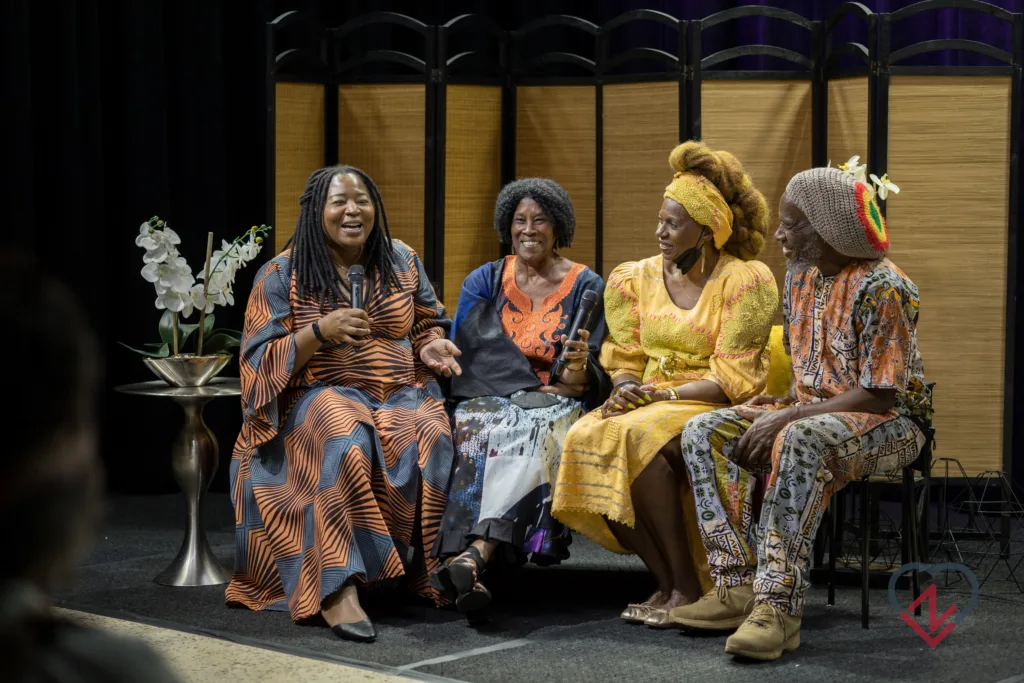
Watch renowned Black Storyteller Charlotte Blake Alston at Love Now Media’s ‘Gift of the Griot’ program.

This article was written by Love Now Media's Marketing and Communications team with the support of an artificial intelligence writing and research tool. The goal of the article is to offer relevant information about our work to deepen our relationships with our readers and raise awareness about the importance of our work.