
it feels taboo to
name it in the moment(s) but
you’re sinking deeper

than you swam somehow
convinced enough people to
recognize maybe

this is not who I
am the picture of “how are
you doing?” glitch

between missed hangouts,
forgotten showers, and skipped
meals a restless ache

no sleep instead they
reply you don’t look well
and nothing gets done

with that observation
when you start to realize
who, if anyone, can hear

the silent cries welled
beneath a force of medi
cated armor, teeth baring

Trojan horse becomes
tiresome routine you don’t
notice ‘til you are

beyond knees deep
knocking on God’s door early
drowning in a des

pair so full it’s leak
ing onto everything &
you can’t grip to find

the (w)hole festering
in your soul contrary to
popular and brief

notes on fighting this
series of behaviors aren’t
you, the final bell

you are still here—and
a string of warning signs mur
mur it might be time

cast off these burdens
no, you are not one of them
burden cannot hold

your name allow the
flag of your pain to ping the
alarm the lifeguard heavy

heart pull you out, ring
the bell  shatter the tempered
glass  carry your

stirred bones back to shore
shake you awake, remember
how to float amid

the rolling tides of  a life
you so clearly want to live
soon, submerge the hooves

of your body head up
in the water every ten
seconds standing waist

deep bubbling the
current with a friend by your
side, a fighter re-

learning how to swim
coax memory into motion
on the seas of life again
Edited by Ursula Rucker and Yolanda Wisher
In “haikuism: (not) wanting to die,” Deborah Olatunji explores her own relationship with depression and suicidal ideation from her teenage years to early adulthood. Moved by the compassion of strangers and friends in one of her darkest moments, she hopes this poem reminds people that suicide prevention requires proper attention and community support to those struggling and from those around to witness us.
Our communities must be equipped with the resources to talk about suicidal ideation and prevention. It’s still a critical wellness issue to destigmatize within African and Afro-diasporic cultures. Having these conversations helps to ensure we get the care we need. It takes an active and attentive village: https://www.ebony.com/meet-the-organization-fighting-for-black-suicide-prevention/
The American Psychological Association reports “approximately 80% of people who attempt suicide show warning signs beforehand.” It’s important to know some of the warning signs and how you can help: https://www.udel.edu/academics/colleges/canr/news/2026/september/spotting-the-signs-suicide-prevention-month/
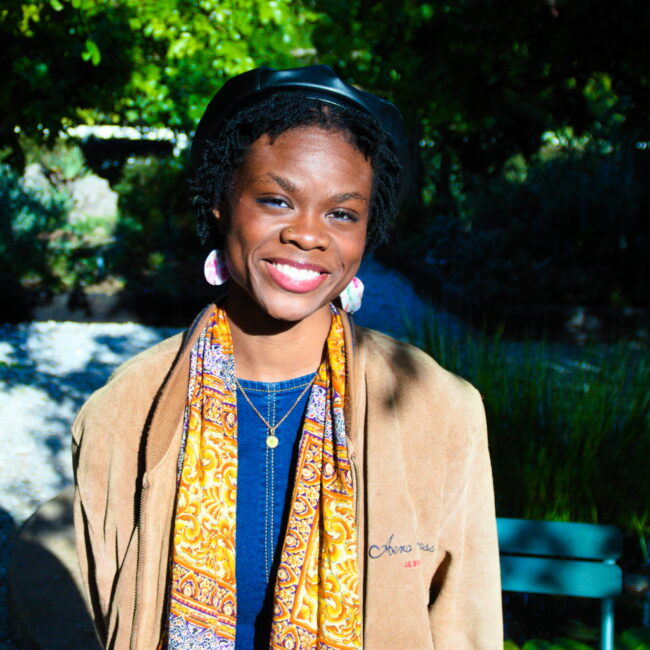
Deborah Olatunji (she/her) is a Nigerian-American poet and educator. Her work foregrounds the experiences of Black and African people with a focus on women’s history, sonic traditions, geological processes, and Pan-African world-building. Her interdisciplinary practice flows between poetry, archival research, curatorial practice, arts education, and community-based infrastructure. She holds a BA in Psychology from the University of Pennsylvania and BA (Hons) in Historical Studies from the University of the Western Cape (UWC). Her poem, “LOVE LETTER TO MY SISTERS AND BLACK WOMEN, AFRICAN SONGBIRDS ON THE PLANET EVERYWHERE,” won first place for the 2026 Shout Mouse Press Bright Before Us Contest, selected by José Olivarez. Her work appears in The Woodlands Magazine and elsewhere. Deborah is a recipient of the Imagining America-Joy of Giving Something Fellowship (2022) and Zeitz Museum of Contemporary Art Africa (MOCAA) and UWC Fellowship (2025). She believes sister is a verb and Black women are the answer. Àṣẹ.